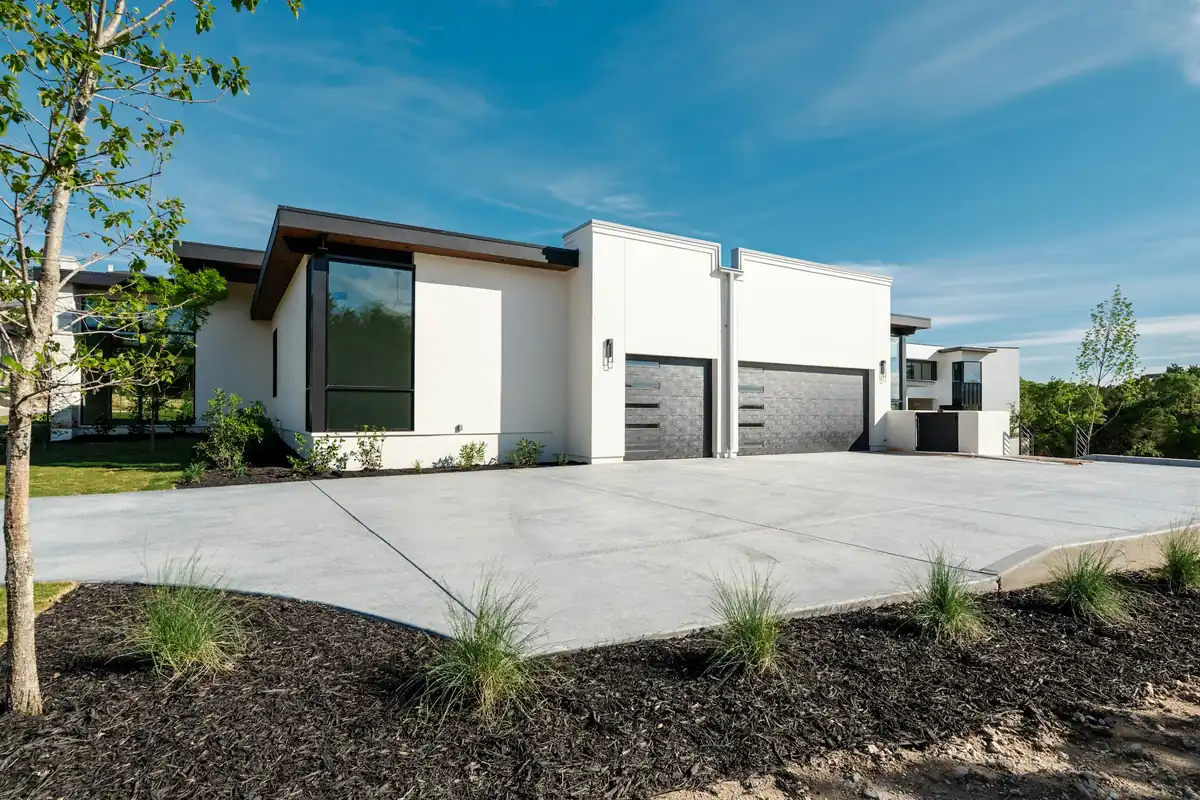
Concrete Driveway Contractors Near Me in Pflugerville
New drives, tear-out and replacement, and widening, from the garage door to the curb line, with the city’s approach rules handled in the scope.
Stock photo
Free Driveway Estimates Start at the Curb
Request a Concrete Site Visit
Tell us what you want built or fixed and roughly where. We reply to set a time to walk the site. Rather talk? Call (737) 201-0849.
Tell us whether you want a new drive, a replacement, or a few more feet of width. We walk it with you, starting where most driveway trouble starts: at the approach, where your concrete meets the city’s street.
- We measure the drive, the approach and the fall to the street.
- We sound the old slab with a chain before saying replace or widen.
- The written scope names the base, joints, finish and any permit.
Driveway Pavement Built for Blackland Clay and Texas Heat
A driveway in Pflugerville carries two loads at once: the cars on top, and the clay underneath that swells after a wet spring and shrinks through an August dry spell. Houston Black clay, the most common soil across this part of Travis County, can open cracks up to 4 in. wide when it dries out. A slab poured straight onto it, without compacted select fill and reinforcement, moves in pieces.
Heat is the second load. Summer pours start at first light, fog spray and evaporation retarder go on behind the screed, and white curing compound goes on the moment the surface is ready, because a drive that dries too fast cracks before anyone parks on it.
That is the work we do as a concrete contractor in Pflugerville: the same finish you see on any new drive, built on the parts you don’t.
What Our Driveway Installer Settles at the Curb
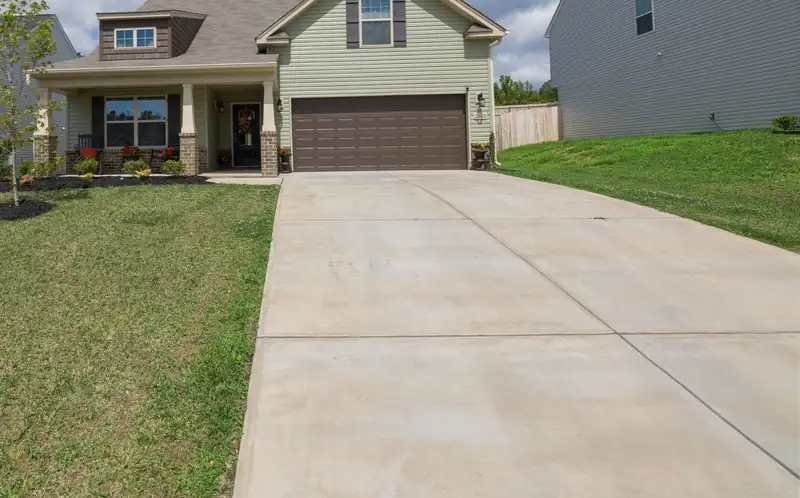
In Pflugerville the bottom of your driveway, from the property line to the street, is a “Type I driveway approach” in city right-of-way. It has its own rules.
The Approach Permit
Work in the right-of-way needs a permit before it starts (City Code §96.02), and the city typically issues or denies one within ten days of a complete application (§96.16). Development Engineering gets 48 hours’ notice before we begin.
The Curb Cut
When a curb comes out for access, it is saw-cut, not broken out with a hammer (§150.23(B)), so the line the city sees afterward is straight and the gutter stays intact.
Where the Walk Crosses
Where the drive crosses the public sidewalk, its slope stays at 2% or less for at least 3 ft, matching the walk’s cross slope (UDC §10.2.1). The rest of the drive may be no steeper than 14%.
The Approach Stays in Your Frontage
The approach and its curb returns stay inside your lot’s street frontage unless the neighbor gives written approval, and they meet the street at about 90 degrees.
Approach Spacing at Corners and Inlets
On local streets a driveway stays 50 ft from a corner, edge to edge, where the lot allows it, and 10 ft from a curb inlet opening to the edge of the curb return.
The Joint at the Line
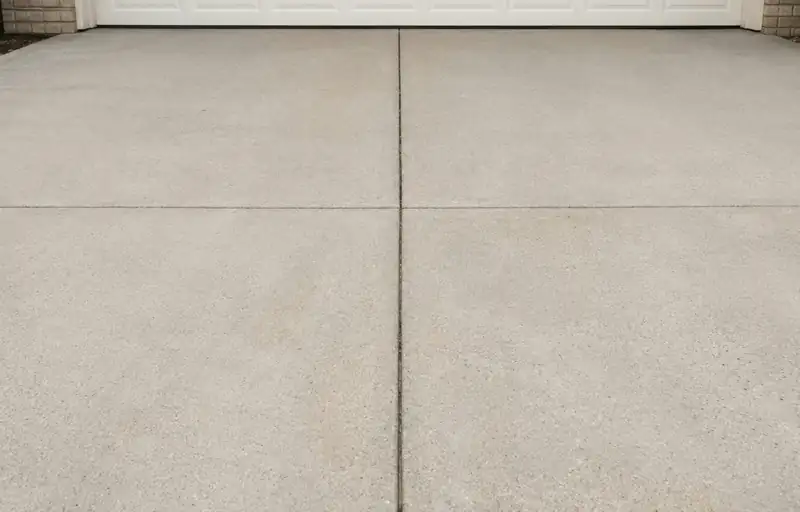
An expansion joint goes in at the property line, separating the city’s approach from your drive so each can move without breaking the other.
Cross-Slope Level: check the grade of a drive
Tilt the level with the buttons or the arrow keys. The list shows which Pflugerville and TxDOT limits a surface at that grade still meets.
2.0% to start. Tilt it to compare.
- Where your drive crosses the public walk, Pflugerville holds it to 2% for at least 3 ft (UDC §10.2.1).
- Curb ramps at the corner top out at 8.3% (TxDOT Item 531); a drive never needs to be that gentle.
- Ramp side flares stop at 10% under TxDOT; past that, only driveway grades remain.
- The steepest a Pflugerville driveway may be, anywhere along it, is 14% (UDC §10.2.1).
Slope is rise over run; the drawing exaggerates the tilt.
Widening Driveways: What Contractors Add at the Old Edge
A third car, a trailer pad, or room to open doors without stepping on the lawn. Widening works when the old slab is sound and the new strip is tied in properly.
Strip Builder: widen a driveway on paper first
Pick a side, a width and how far the strip runs. The plan redraws the new panel, the joint where it meets the old slab, and what changes once it reaches the street.
Blue: new strip. Dashed navy: expansion joint against the old slab. Red ticks: ties drilled into the old edge. Drawn at about 6 px per foot.
About 113 sq ft of new concrete (a planning figure for the drawing, not a price).
- An expansion joint where the new strip meets the old slab. Pflugerville's code asks for one at every joint between new and existing construction (City Code §150.23(C)).
- Ties drilled into the old edge so the strip can't settle away from the driveway on its own.
- The old control joints carried straight across the strip, so cracks have a planned line to follow.
- Stops on your lot. Building Inspections' miscellaneous permit form lists driveways, so we confirm whether your widening needs one.
Most Pflugerville homes were built after 2000, so a lot of drives are original two-car slabs that fit the family that bought the house, not the one living there now. Adding a strip beats replacing the whole drive when the existing concrete rings sound under a chain and its cracks aren’t moving. If a strip will run all the way to the street, it becomes approach work and takes the same right-of-way permit as a new driveway.
How We Spec a Pflugerville Driveway
- Base on clay. Soft spots dug out, select fill brought in and compacted in lifts, and trenches under the drive backfilled with wetted sand or compacted fill (§150.29).
- Strength named. The scope states the concrete strength; TxDOT’s Class A (3,000 psi) for driveways is a common floor, and heavier use goes up from there.
- Steel for clay. Rebar on chairs so it sits in the slab, not on the dirt. Wire mesh only keeps cracks tight; it won’t prevent them (NRMCA). Synthetic fibers help against early shrinkage cracks but don’t replace steel under a drive on clay.
- A mix for heat, not frost. Air entrainment is a freeze-thaw defense, used when the plans call for it (TxDOT Item 421). Here the mix questions that matter more are the strength, how much water gets added at the truck, and the summer pour plan.
- Joints on a plan. Control joints a quarter of the depth, no more than about 15 ft apart, panels kept near square.
- Fall to the street. Water leaves the garage door and heads for the gutter, never back toward the house.
- Cured, not just finished. White curing compound and at least three days before the drive is treated as done.
Tamp: why the base goes in by lifts
Choose how the fill goes in, press Run a pass four times, then pour and load the drive. Watch how deep each pass reaches.
Choose how the fill goes in, then run the compactor.
- Thin lifts: Each lift was compacted before the next one covered it, so the base is firm from the bottom up. The slab sits on even support and the car’s weight spreads into the ground the way the design assumed.
- One deep dump: The compactor tightened the top and left the bottom loose. Under the weight of cars and the first wet season on clay, the loose fill settles, the slab loses support in the middle and cracks across the soft spot. It is the most common way a new driveway fails from below.
Drawing not to scale; the sag is exaggerated so you can see it.
Should You Seal a Driveway After Its First Summer?
For a plain broom-finish drive, sealing is a choice, not a requirement. A penetrating sealer slows down oil and water stains and is easy to reapply. Nobody salts Pflugerville driveways all winter, so the reason northern contractors push sealing every couple of years mostly doesn’t apply here.
A stamped, colored or exposed-aggregate drive is different. Sun fades the color and dulls the surface, and decorative concrete in full sun is typically resealed every two to three years (ASCC). If you are weighing a decorative drive, the stamped and decorative finishes page covers patterns, color and upkeep. Wait until the slab has cured before any sealer goes on; the scope gives the date.
Concrete Driveway Cost: What Moves the Number
Square footage is the start, not the answer. Tear-out and haul-off of the old slab, select fill to replace soft clay, the thickness and steel for what parks there, a curved apron versus a straight one, the finish, and whether a right-of-way permit is involved all change the total.
Two cheaper paths are worth knowing about. A drive that is sound but worn on top can sometimes take a resurfacing overlay, and a drive with one or two bad panels may only need those panels cut out and replaced, which is repair work. We’ll tell you which applies after we sound it. If the public walk across your drive is also failing, the sidewalk page explains who owns that repair.
Concrete Driveway Questions From Pflugerville Lots
The owner does. Pflugerville’s Unified Development Code says the owner does all the work and pays all the costs of building access driveways and their parts in the right-of-way (UDC §10.2.1). The city issues the right-of-way permit; it doesn’t pour or pay for the approach.
Size doesn’t change the answer. Tearing out a driveway, curb or sidewalk in the right-of-way counts as excavation under City Code §96.03, and the only exceptions in §96.15 are small utility service connections. Plan on a right-of-way permit from Development Engineering for any approach work.
On local streets the UDC keeps a driveway at least 50 ft from the intersection, edge to edge, unless the lot’s dimensions make that impossible. It also wants 10 ft between a curb inlet and the edge of the driveway’s curb return. Corner lots are where we measure before anyone sketches.
Whatever parks on it decides that. Two cars and a trash can are one thing; a pickup towing a trailer, or an RV pad down the side of the house, is another and gets a thicker slab and thickened edges. The scope names the thickness and the reinforcement for your use, so you can see it and hold us to it.
An average hides the parts that move your number: how much old concrete comes out, how much select fill the clay underneath needs, the size and shape of the drive, the finish, and whether the approach needs a right-of-way permit. We price your driveway after the walk, in writing, with each of those parts named.
Only if the old slab is sound. We sound it with a chain first; if it rings clear and the cracks are stable, a new strip tied into the old edge works. If large areas sound hollow or the slab has heaved, adding to it just means two problems side by side, and a repair or replacement comes first.
More Concrete Work Around a Driveway
Ready to Walk Your Driveway With Us?
Send the visit request or call. We’ll measure from the garage to the curb and send the scope in writing.
(737) 201-0849 Book a Driveway Visit