Concrete Slab & Foundation Contractors Near Me in Pflugerville
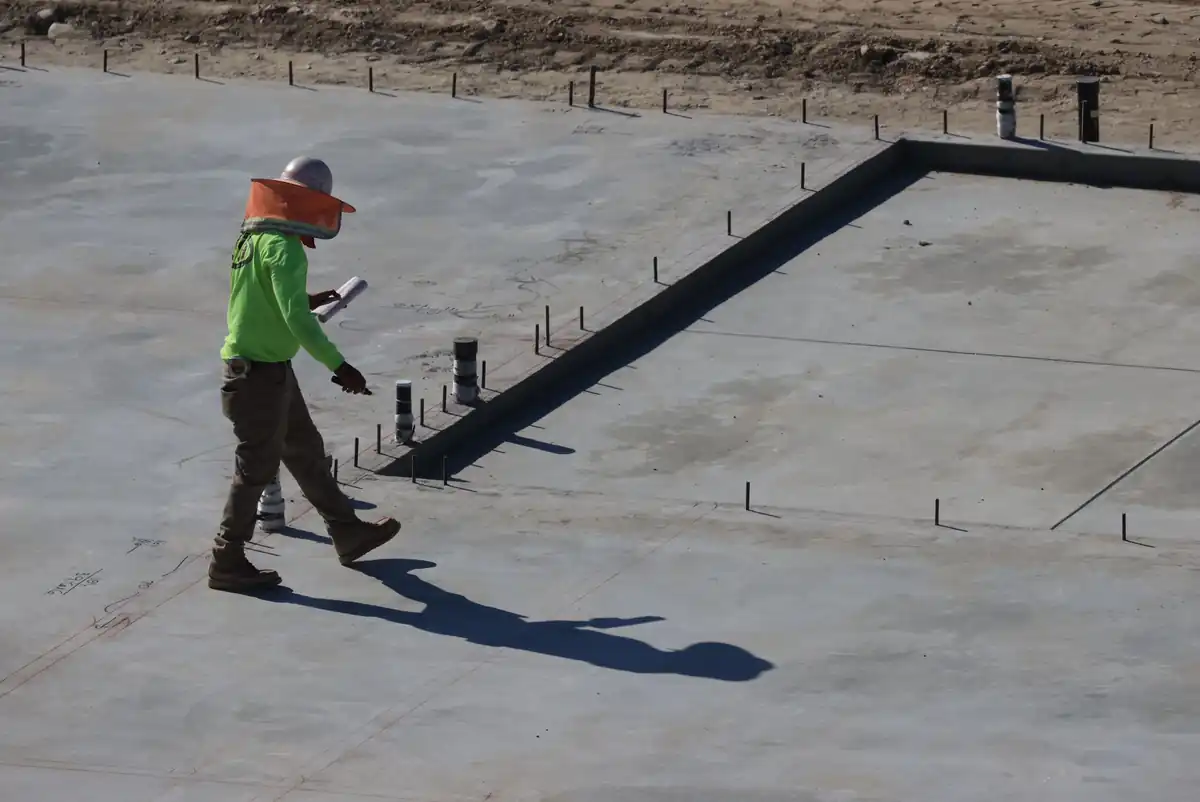
Slabs for additions, garages and shops, and pads for sheds, AC units and hot tubs, built on compacted fill and reinforced for clay that moves.
Stock photo
Book a Slab or Foundation Site Visit
Request a Concrete Site Visit
Tell us what you want built or fixed and roughly where. We reply to set a time to walk the site. Rather talk? Call (737) 201-0849.
Tell us what the slab is for and roughly how big it is. For an addition or a new structure, send the plans if you have them; for a pad, a photo of the spot is enough to start.
- We look at the ground, the drainage and any existing slab nearby.
- We ask for the engineer’s plan when the slab carries a structure.
- The scope names the fill, thickness, beams, steel and curing.
Foundation Contractors and Post-Tensioned Slabs on Expansive Clay
Houston Black, the clay under roughly half of the Pflugerville area, is rated high for shrink-swell by the USDA. When it dries it cracks open, up to 4 in. wide and a foot or more deep; when it wets up it swells and lifts. A foundation on it has to ride that movement as one stiff piece.
That is why the Post-Tensioning Institute calls post-tensioned slab-on-ground the most common residential foundation in Texas: steel tendons, stressed after the pour, squeeze the slab together so it resists cracking and bending. Its design comes from an engineer working to PTI’s standard, and the build follows that stamped plan.
For smaller slabs and pads, conventional rebar on chairs, thickened edges, and a properly compacted pad of select fill do the same job at a smaller scale.
What Goes Under and Inside a Concrete Slab
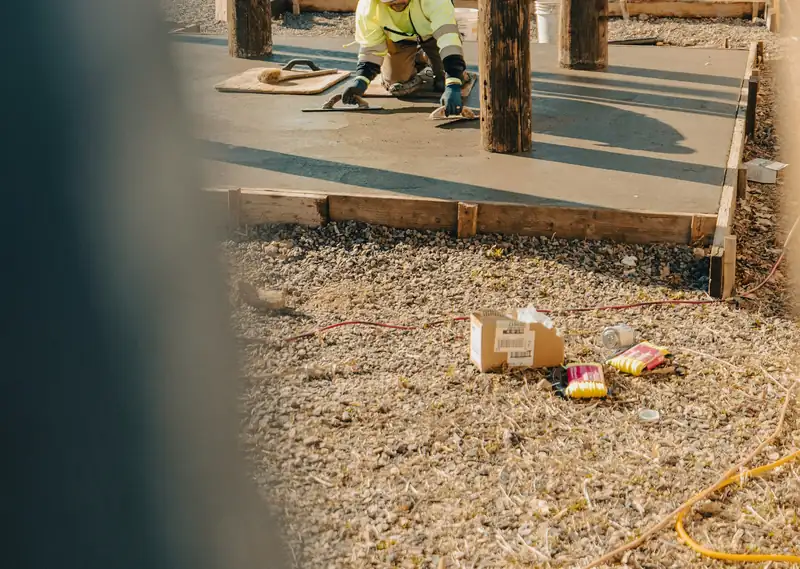
Everything that decides how a slab behaves is buried by the time you see it. Open the drawers to see what goes in, in order.
Drawer Cabinet: what’s under and inside the slab
Open one drawer at a time, from the dirt up.
Topsoil and roots stripped, soft spots dug out. On Houston Black clay the goal is a stable, evenly moist subgrade, because clay that is bone-dry on pour day swells under the slab after the first long rain.
Imported fill placed and compacted in lifts to build the pad up to grade. Trenches cut for plumbing or conduit are backfilled with wetted sand or compacted fill, no rock over half an inch (City Code §150.29).
Trenched perimeter and interior beams stiffen the slab so it moves as one piece when the clay moves. Their size and spacing come from the engineer on a foundation, and from the load on a pad.
A polyethylene sheet under interior slabs slows ground moisture wicking up into flooring. Laps are taped and penetrations sealed so it actually works.
Rebar on chairs so it sits inside the slab, or post-tensioning tendons laid out to the engineer’s plan. A PT slab is never drilled or cut afterward.
Stub-outs, sleeves and anchor bolts set and checked before the truck arrives. Moving a drain after the pour means breaking concrete.
The specified strength placed and finished, then a white curing compound (ASTM C309 or C1315) sprayed as soon as the surface allows. The slab stays protected from drying for days, not hours, because that is when it gains most of its strength.
Concrete Pad Contractors: Sheds, Hot Tubs, Condensers and Shop Floors
Pads are small slabs with specific jobs. A shed pad needs to be level and a little above grade so water runs off, not under. An AC pad needs to stay put next to a foundation that moves. A hot tub pad carries a lot of weight in a small footprint. A shop slab may need to take a vehicle, a lift, or a trailer backing in.
Each gets a thickness, edge detail and steel matched to that load, and a fall that keeps water away from whatever sits on it. If the pad sits next to the house, it gets an isolation joint, never dowels into the foundation. Pads near a planned patio are worth pouring as part of the same job.
Set-Down Test: what is this pad for?
Pick what will sit on the pad, then press and hold the button (or tap it) to set it down. Watch where the pad works hardest.
Shed and what’s in it: Weight spread over the whole pad. The pad is level and sits a little above grade so rain runs off, not under the shed. The scope names the thickness and the edge detail.
- Shed and what’s in it: Weight spread over the whole pad. The pad is level and sits a little above grade so rain runs off, not under the shed. The scope names the thickness and the edge detail.
- Hot tub, filled: A lot of weight in a small footprint. Thickness and steel are matched to it, the base under it is compacted evenly, and the tub maker’s own pad requirements go into the scope.
- AC condenser: A light load beside a foundation that moves with the clay. The pad gets an isolation joint at the house and is never doweled into the foundation, so it can move on its own.
- Car or trailer in a shop: Wheel loads that roll on and stop in the same places. The scope names a thickness and steel for the heaviest thing that will park or back in, not the average one.
Drawn to show where a load bears, not to size anything; the bow is exaggerated. Your scope gives the pad’s real thickness and steel.
Foundation Pouring Near Me: 811 Locates Before the First Shovel
Beams, footings and plumbing trenches all go into the ground, so every slab job starts with a locate ticket.
Flag Key: what the locate marks mean
Tap a flag in the rack to plant it along the line it marks on this sample lot. The table lists every colour.
Tap a flag to see what it marks around a slab.
| Colour | Marks | What it means on your lot |
|---|---|---|
| White | Proposed excavation | We paint the slab outline in white before calling in the ticket, so locators know which patch of yard matters. |
| Pink | Temporary survey markings | Survey stakes for a new addition; they mark lines on paper, not anything buried. |
| Red | Electric power lines, cables, conduit | Power to the house, from a box near the street to the meter. Additions often sit close to it. |
| Yellow | Gas, oil, steam, petroleum | Gas service to the meter. A line on to an outdoor kitchen is private and stays unmarked. |
| Orange | Communication, alarm or signal lines, cables, conduit | Cable and fiber drops run shallow, so footings near them are dug by hand. |
| Blue | Potable water | Water from the curbside meter box to the house is private; the utility marks only its side. |
| Purple | Reclaimed water, irrigation and slurry lines | Reclaimed water gets marked; your own sprinkler lines don’t, so we ask where the zones run. |
| Green | Sewers and drain lines | The sewer lateral leaves the house toward the street; a new slab can’t bury its cleanout. |
Colours: Texas811 color code. Runs drawn for illustration only.
Texas law requires notice to the one-call center no later than two business days before excavating, and no earlier than 14 days (Tex. Util. Code §251.151). Each excavator needs its own ticket. Utilities mark their lines up to the meter; sprinkler lines, a gas line to an outdoor kitchen and other private runs are yours to point out.
What Concrete Slab Contractors Check Before a Pour
- The plan. Dimensions, beam layout and steel match the engineer’s drawings or the scope.
- The pad. Compaction done, grades shot, and the pad evenly moist, not mud and not dust.
- Penetrations. Every pipe, sleeve and anchor where the plan says, and the plumber has signed off.
- Inspections. Any required city inspection passed before concrete is ordered.
- The weather. A first-light start in summer; on a hard freeze watch, like February 2021, the pour moves.
- The cure. Curing compound and water on site before the first truck.
A cracked slab elsewhere on the property is a different job; the concrete repair page covers that. For the bigger picture, see our work as a Pflugerville concrete contractor.
Concrete Foundation and Slab Cost: What Drives It
Size and thickness are the start. Then come the dirt work (how much fill it takes to build a level pad), the beam layout, the steel, plumbing and sleeves set before the pour, pumping if the truck can’t reach, and the inspections the job needs. Engineering and the building permit are their own lines.
For a pad, the biggest swing is usually access and how far the ground has to be built up. For an addition, it is what the engineer’s plan calls for. Either way, each of those parts is priced separately in the written scope.
Questions About Building a Foundation on Blackland Clay
That depends on what is moving. Raising or underpinning an existing house with piers is a foundation repair specialist’s work, and we will say so on the walk. We pour new slabs, pads, additions and footings, and we replace cracked flatwork around a house once the movement under it is understood.
For anything that carries a house or an addition, plan on engineered plans and a building permit; Pflugerville builds to the 2021 International Residential Code with local amendments. A post-tensioned foundation is designed to the Post-Tensioning Institute’s DC10.5 standard. A shed or AC pad usually doesn’t need an engineer, but we confirm with Building Inspections.
Yes, following the engineer’s connection detail and without drilling into the existing PT slab. The tendons in it are under high tension, so how the new slab meets the old one is designed, not improvised on pour day.
What sits on it decides that. A garden shed, an AC condenser, a hot tub full of water and a shop with a vehicle lift are four different loads. The scope names the thickness, edge detail and reinforcement for yours.
Because footings, grade beams and plumbing trenches all dig into the yard. Texas law requires notice at least two business days before excavating, even on your own property, and each excavator needs its own ticket. We call ours in; private lines like sprinklers still need pointing out.
Yes, with a heat plan. Normal highs stay at 90°F or above from late May to late September, so the pour starts at first light, the subgrade is dampened, an evaporation retarder goes on if the surface dries too fast, and curing compound follows immediately. Curing lasts at least three days.
Concrete Work That Starts With a Slab
Ready to Talk Through Your Slab?
Send the size, what it will carry, and any plans you have. We’ll walk the spot and send the slab scope in writing.
(737) 201-0849 Book a Slab Visit