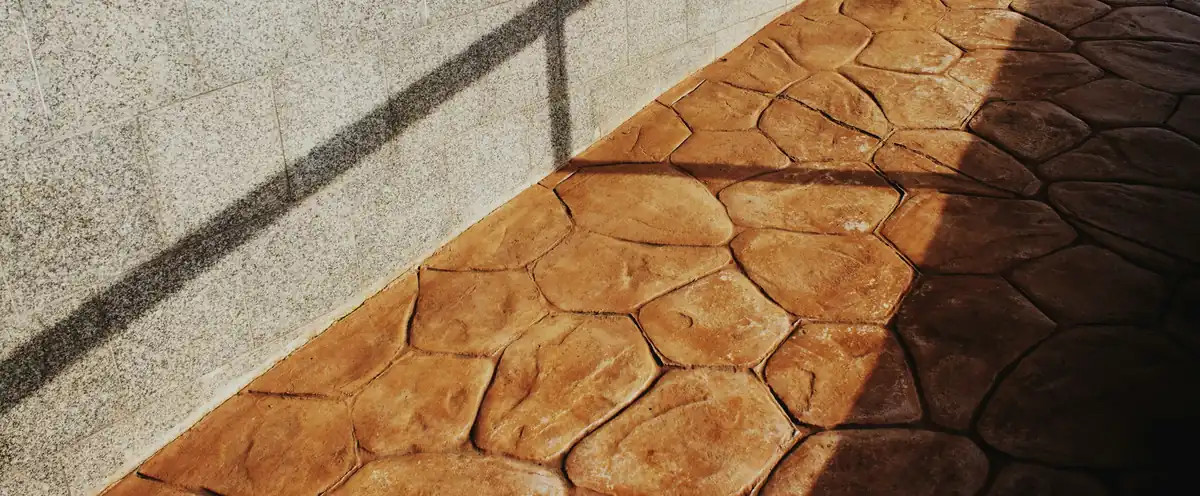
Stamped Concrete Patio & Decorative Finishes in Pflugerville
Slate, plank and cobble patterns, integral color, borders and exposed aggregate, poured in one pass and sealed against the sun.
Stock photo
Book a Stamped Concrete Walk-Through
Request a Concrete Site Visit
Tell us what you want built or fixed and roughly where. We reply to set a time to walk the site. Rather talk? Call (737) 201-0849.
Stamped concrete is a new pour with a pattern pressed in while it is still plastic, so it starts with the same walk as any slab: where water goes, what it ties into, and what is underneath. Then we talk pattern and color.
- Bring photos of patterns you like; we bring real texture notes.
- We check the fall, the house slab and any pool coping.
- The scope names the pattern, colors, sealer and joint layout.
Custom Concrete Patterns, Textures and Color
Pick by feel and upkeep, not just by look. Every finish below behaves differently underfoot and in the sun.
Specimen Tray: decorative finishes up close
Tap a specimen to zoom in and read how it feels, how it handles sun, and what it needs over the years.
-
Ashlar or random slate pressed into colored concrete, with recessed grout lines.
- Underfoot
- Textured stone faces; grippy unless sealed glossy.
- In the sun
- Color fades in UV without a sealer.
- Upkeep
- Reseal every 2 to 3 years in full sun (ASCC).
-
Board lines and grain stamped in a warm brown, laid like decking.
- Underfoot
- Fine grain texture; comfortable barefoot when sealed matte.
- In the sun
- Darker browns run hotter in afternoon sun.
- Upkeep
- Same resealing rhythm as any stamped color.
-
A contrasting band around a field, often red against gray. The stock photo may show real pavers; it is here for the look.
- Underfoot
- Flat bands, crisp joints.
- In the sun
- Strong reds show fade first, so seal them well.
- Upkeep
- Reseal with the field; touch up the band color if it chalks.
-
The top paste washed off to expose rounded stone set in the slab.
- Underfoot
- Bumpy and very grippy; not for bare feet on a hot day.
- In the sun
- The stone doesn’t fade; the paste around it can.
- Upkeep
- A penetrating sealer keeps stones from loosening at the edges.
-
Smaller stone exposed lightly for a sandpaper texture.
- Underfoot
- Even, grippy, good around pools.
- In the sun
- Lighter color stays cooler than dark stamped colors.
- Upkeep
- Low; seal to keep stains out.
-
Plain gray concrete dragged with a broom, for comparison.
- Underfoot
- Fine ridges, good traction.
- In the sun
- Nothing to fade.
- Upkeep
- Sealing optional.
Texture drawings are illustrations; photos are licensed stock, for illustration only.
Stamp Cement or Stain It: Color That Survives Texas Sun
Color can go in three places, and where it goes decides how it ages. Integral color is mixed into the whole load, so a chip shows the same color underneath. Color hardener is broadcast onto the fresh surface and floated in, giving a stronger surface tint. A release powder or liquid keeps the stamps from sticking and leaves darker tones in the low spots, which is where the “stone” depth comes from. Stain goes on after the slab cures, and is the easiest to refresh later.
In a Pflugerville back yard the enemy is UV, not freeze-thaw. A sealer protects the color, and in full sun decorative concrete is typically resealed every two to three years. Darker colors look rich on day one and run hotter by August, which matters on a patio where people walk barefoot.
Heat also matters on pour day. Stamping happens in a short window while the surface is still soft, and summer heat shortens it. That is why stamped pours here start at first light, with enough hands on site to finish the pattern before the slab gets away from the crew.
Knock-On Chain: how one stamped choice moves the others
Pick an option in any of the five links. The links it affects light up with a note saying how.
-
Color method
Mixed into the whole load, so a chip shows the same color underneath.
Broadcast on the fresh surface and floated in, for a stronger surface tint.
Goes on after the slab cures; the easiest color to refresh later.
- Release: Clear release With no accent tone, the base color carries the whole look.
- Pattern: Wood plank Darker browns run hotter in afternoon sun, which matters barefoot.
- Where it goes: Driveway The part in the city right-of-way is a Type I approach; we confirm what finish is allowed there first.
-
Release
Leaves darker tones in the low spots, which is where the stone depth comes from.
Keeps the stamps from sticking without adding a second tone.
-
Pattern
Ashlar or random slate with recessed grout lines; control joints are cut along them so they disappear.
Board lines and grain, often in a warm brown.
Heavy stone or cobble texture with deep low spots.
- Color method: Hardener One more step inside the stamping window, so summer pours need more hands and a first-light start.
- Sealer: Slip-resistant Pairs well with a rougher texture where feet are wet.
- Where it goes: Pool deck Choose a rougher texture, or a broom or exposed-aggregate band at the coping.
- Where it goes: Driveway Many owners stamp only the border or walk and broom-finish the wheel paths.
-
Sealer
Deepens the color and shows it off.
A sealer with a grit additive, often a lower sheen.
- Color method: Integral Color runs all the way through, but the surface still fades in UV, so it still gets sealed and resealed.
- Color method: Stain The sealer is what protects a stained surface in sun; refreshing it later means restaining and resealing.
- Release: Tinted release The loose release is washed off once the slab cures, before the sealer goes on.
- Pattern: Slate Textured stone faces stay grippy unless the sealer is glossy.
- Where it goes: Back patio Full sun means resealing every two to three years (ASCC).
- Where it goes: Pool deck Steer toward a slip-resistant sealer.
-
Where it goes
Foot traffic, furniture, sun most of the day.
Wet feet, splash-out and bright sun.
Cars, turning tires and oil.
- Pattern: Deep texture On a driveway, deep texture traps grit where tires scrub; many owners keep it to the border.
- Sealer: Glossy Around a pool, glossy on a smooth pattern is slick when wet.
Pick an option in any link to see what it pulls along.
A Stamped Driveway Needs More Planning Than a Patio
A stamped drive carries cars, turning tires and oil, so the base, thickness and steel follow the same rules as any concrete driveway, and the pattern sits on top of that. Deep-textured patterns trap grit where tires scrub, so many owners keep the pattern to a border or the walk and leave the wheel paths broom-finished.
The approach at the street is a second question. The part between your property line and the curb is city right-of-way, built as a Type I approach under its own rules (UDC §10.2.1), so we confirm with the city what finish is allowed there before anyone picks a pattern for it.
Stampcrete Patio Approval: Building the HOA Packet
A pattern and color are the first things an architectural committee asks about. Send everything at once and the review goes faster.
Packet Composer: a cover sheet for your HOA
Choose the project, finish and HOA status. The cover sheet lists what to attach; print it, or copy it into your visit request.
Exterior change cover sheet
- Your survey, marked up with the outline of the stamped area and how far it sits from each lot line.
- The pattern name and color names, with a manufacturer photo or a sample board for the committee.
- Which way the decorative slab drains, and where that water ends up in the yard.
- Who is pouring it, how to reach them, and roughly when the work would start.
- The committee’s own change request form, usually found in the owner portal.
- Room in the calendar. Falcon Pointe posts that its committee may take up to 30 days, so the stamping date waits for the letter.
- Any border, accent band or second color spelled out, so the committee approves the exact design.
- A note on the approach: city rules govern the right-of-way part, and that permit is separate from the HOA.
- A cover over the stamped patio goes on the city’s miscellaneous permit form; its wiring needs a master electrician’s permit.
- The wall’s height, face finish and drainage behind it, if it frames the decorative area.
A checklist only; your HOA’s own rules decide.
Plain or stamped, a new patio also has to drain away from the house and tie in without cutting a post-tensioned foundation; the concrete patio page covers those parts.
How a Stamped Slab Goes Down
- Base and forms like any slab: compacted fill, steel, and a fall away from the house.
- Color in the mix or broadcast as hardener on the fresh surface.
- Release spread so the stamps lift clean and the low spots take the darker tone.
- Stamping in sequence across the slab while it will still take the texture, with edges and corners hand-tooled.
- Joints cut along the pattern lines so they disappear into the design.
- Wash and seal once it cures, then reseal on a two-to-three-year rhythm in full sun.
Pricing it, choosing it and living with it all start from what you see on the Pflugerville concrete contractor visit.
Stamped Concrete Cost per Square Foot: What Sets It
The slab underneath costs about what a plain slab of the same size costs. The stamped premium comes from the hours inside a short working window: more finishers on site, color and release, the stamp mats, hand-tooling around steps and drains, and the sealer. A single pattern in one color sits at the simpler end; a border in a second pattern, extra accent colors and lots of edges add time.
Two ways to stretch a budget: stamp the border or the seating area and broom-finish the rest, or choose exposed aggregate, which has no stamping step.
Stamped Concrete Questions for Pflugerville Yards
That comes down to sealing more than to the stamp. UV is what fades decorative concrete, and a sealed surface holds its color far longer than a bare one. In full sun, plan on resealing every two to three years (ASCC); the first sign it is due is a patchy, chalky look where the sun hits hardest.
It depends on the texture and the sealer. A glossy sealer on a smooth pattern is slick when wet, so around a pool we steer toward a rougher texture and a sealer with a slip-resistant additive. Exposed aggregate or a broom band at the coping edge is another answer.
Only if the existing slab is sound. A thin stamped overlay bonds to the old concrete, so any hollow or moving areas show through it. We sound the slab with a chain first; the resurfacing and overlay page explains when that works.
It shrinks and moves the same way, so it needs control joints like any slab. The difference is where they go: we lay them out along the pattern’s grout lines so the joint reads as part of the design instead of a cut through a “stone”.
A per-foot number hides what actually changes the price: the pattern, how many colors and borders, how much hand-tooling around steps and drains, tear-out, access, and sealing. We price your design after the walk, in writing, so you can see what a simpler pattern or one less color would save.
Check your deed restrictions, but in many Pflugerville neighborhoods the answer is yes. Meadows of Blackhawk’s posted CC&Rs require prior written ARC approval for improvements, and Falcon Pointe says every exterior modification needs approval, with up to 30 days for review. The packet builder on this page lists what to send.
Concrete Work That Pairs With a Stamped Finish
Ready to Pick a Pattern for Your Concrete?
Send a few photos of patterns you like with the visit request. We’ll bring the texture notes and walk the space with you.
(737) 201-0849 Book a Pattern Visit